
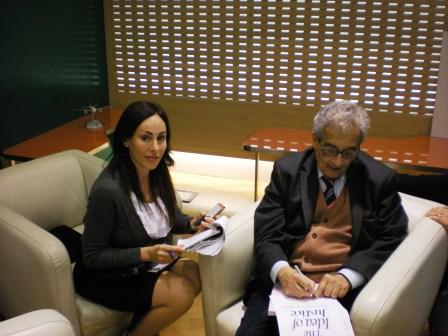
Paola de Rosa specializes in consecutive interpreting in Italian, English, Brazilian Portuguese and French, providing language support during international conferences, audits, depositions, press conferences, company visits, business missions, and assistance to Italian delegations abroad or incoming delegations
🗣️ What is consecutive interpreting?
Without headphones or booths, the interpreter listens and takes notes using a technique called “note-taking“. This technique is specific to consecutive interpreting and should not be confused with shorthand, as the interpreter only needs to note down key concepts and use their own symbols and abbreviations; it is not a rigid system like shorthand. The goal is to capture the meaning of the speech so that it can then be reproduced orally in another language.
Three to five minute turns: each section of the speech is translated by the interpreter while the speaker remains silent, and the speaker’s speech in the source language and the interpreter’s speech in the target language alternate.
One foreign language at a time: this is the most efficient solution when only one main language combination is required.
🎯 When to choose consecutive interpreting (and when not to)
Yes to consecutive interpreting if:
- events in theaters, cinemas, and squares where it is not possible for logistical or budget limitations to organize a simultaneous interpretation service
- medium-small audiences, formal or technical contexts.
- preferably a single language pair (Italian<>English, for example)
Simultaneous interpretation is preferable if:
- multiple languages in parallel.
- fast pace and full day events
- events with strong continuous interaction such as debates.
 🧭 How it works (step by step)
- Briefing with the client: objectives, work schedule, speakers, terminology.
- Preparation: study of materials, creation of glossary (acronyms, terminology).
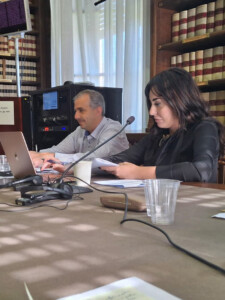
- Setup: definition of the alternation between the speaker and the interpreter and the length of the speaker’s presentation for each segment of speech to be translated, the position of the interpreter who can be standing or sitting next to the speaker (of fundamental importance so that the interpreter can hear clearly and, if necessary, confer with the speaker for possible clarifications).
- Presentation: the speaker presents in the foreign language or source language (3–5 minutes), the interpreter takes notes and then translates into the target language.
- Q&A: questions and answers in short exchanges (30–60 seconds) if included in the agenda.
- Closing: debriefing, if applicable.
⏱️ Timing and organization
The duration of each speech is almost doubled: 10 minutes of speech will take about 7 minutes to be translated in the target language. The interpreter’s translation may be slightly shorter as repetitions can be eliminated.
🏛️💻 On-site and remote setup
In person
- Layout: speaker and interpreter side by side or on a podium; shared or dedicated microphone.
- Visits to departments/construction sites: portable microphone preferred; moderate walking speed.
Remote (Zoom/Teams/Webex)
- Interventions in blocks; the speaker signals the end of the segment.
- Clear rules to avoid overlapping to be agreed ( if possible) in advance with the speaker.
📚 Practical examples
1) 🎙️ Institutional press conference
- Scenario: Mayor (IT) welcomes Ambassador (FR).
- Flow: 4′ speech in FR → 4′ 3′ translated in IT; Q&A with questions in IT (translated using the chuchotage technique to the Ambassador) and answers in FR, translated in IT at the microphone
- Objective: clear political messages and accurate quotes for the media.
2) 🏭 Factory visit / safety briefing
- Scenario: Production Manager (IT) explains HSE procedures to UK partner
- Flow: 3-minute stops in front of workstations → translated in EN
- Objective: to understand processes, risks, and evacuation plans without ambiguity.
3) 🧑🏫 Technical training/testing
- Scenario: FR supplier trains IT team on a machine.
- Flow: 5-minute modules with demonstrations; delivery in IT; specific Q&A with terms from the glossary.
- Objective: transfer of know-how and correct execution of procedures.
4) 🍽️ P Business lunch/negotiation
- Scenario: EN buyer and IT company define an agreement
- Flow: short segments, discreet tone; the interpreter politely signals natural pauses.
- Objective: to clarify prices, times, and guarantees while maintaining a friendly negotiating atmosphere.
5) 🤝 Business mission/delegation
- Scenario: FR delegation on a roadshow with institutions and companies.
- Flow: formal greetings, company presentations, B2B meetings; alternating IT↔FR interpretation.
- Objective: enhance the positioning of the institution and facilitate matchmaking.
🌟 Added value of the interpreter
- Professional notetaking: symbols, logical structures, discourse markers.
- Pacing control: complete segments, no overlapping.
- Terminological consistency: numbers, dates, names, units of measurement always correct.
- Register and nuances: tone, formality, cultural implications maintained.
✅ Best practices for speakers and organizers
- Share slides, speeches, and abstracts in advance (including drafts).
- Prefer complete sentences and natural pauses every 3–5 minutes.
- Avoid reading too quickly or listing numbers without visual support.
- Provide interpreters with the speeches to be read in advance.
- Have a moderator who sets the pace.
- Write down proper names (people, brands, places).
Questions and answers about consecutive interpreting
What is consecutive interpreting?
It is a technique in which the interpreter listens to the speaker’s speech and takes notes (this is not shorthand: notetaking is taught at interpreting schools, but each professional adapts this technique according to their preferences); at the end of short sections (3-5 minutes), they reproduce the content in the target language. It does not take place simultaneously, but alternately with the speaker, who pauses (they are not interrupted by the interpreter) to allow the professional to translate.
When is it recommended?
It is ideal for bilingual events, such as press conferences, company presentations, bilateral talks, official ceremonies, or institutional visits, where technical equipment is not available or necessary.
What is the difference between simultaneous, consecutive, and whispered interpreting?
- Simultaneous: for large events and multiple languages → requires technical equipment.
- Consecutive: for official events on stage in theaters or cinemas or even small groups → more time, but no technology. Consecutive interpreting is often combined with chuchotage. For example, the interpreter whispers the questions asked by journalists to the interviewee, but then the answer is translated into the microphone or aloud to the entire audience.
- Whispered interpreting: It may or may not be combined with consecutive interpreting: for one or two guests → agile and discreet solution, no equipment required.
How many languages can this type of interpreting cover?
It is recommended when working with a single foreign language, i.e., from Italian to another language (English or French) or vice versa.
Is technical equipment such as microphones or booths required?
No, no technical equipment is necessary. The interpreter usually stands next to the speaker and takes notes using a specific technique, then conveys the message into the target language.
How much longer does the speech take?
The time required is almost doubled, as each section of the speech is first delivered by the speaker and then translated. It is important to plan the duration of the event taking this into account.
What skills does a consecutive interpreter need?
The interpreter must have excellent listening, summarizing, and memory skills, as well as effective note-taking techniques to accurately reproduce complex and articulate content.
Is consecutive interpreting less accurate than simultaneous interpreting?
No, it is not less accurate but more concise (repetitions and hesitations present in spontaneous speech are eliminated) and often allows for greater attention to content (in case of doubt, it is acceptable to ask for clarification). However, it may be less suitable for events with many speakers or tight schedules, such as debates and Q&A sessions.
Is it also suitable for remote events?
Yes, consecutive interpreting is also well suited to videoconferences or online meetings, without the need for platforms other than those commonly used, such as Zoom or Teams.
Which languages do I work in?
The service is available in Italian, English, Brazilian Portuguese and French, for both in-person and remote events.
How can I request a quote?
Simply fill out the form on the Request a Quote page, indicating:
- the date and location of the event
- language combinations required
- estimated duration
- number of participants
- Program of the event