
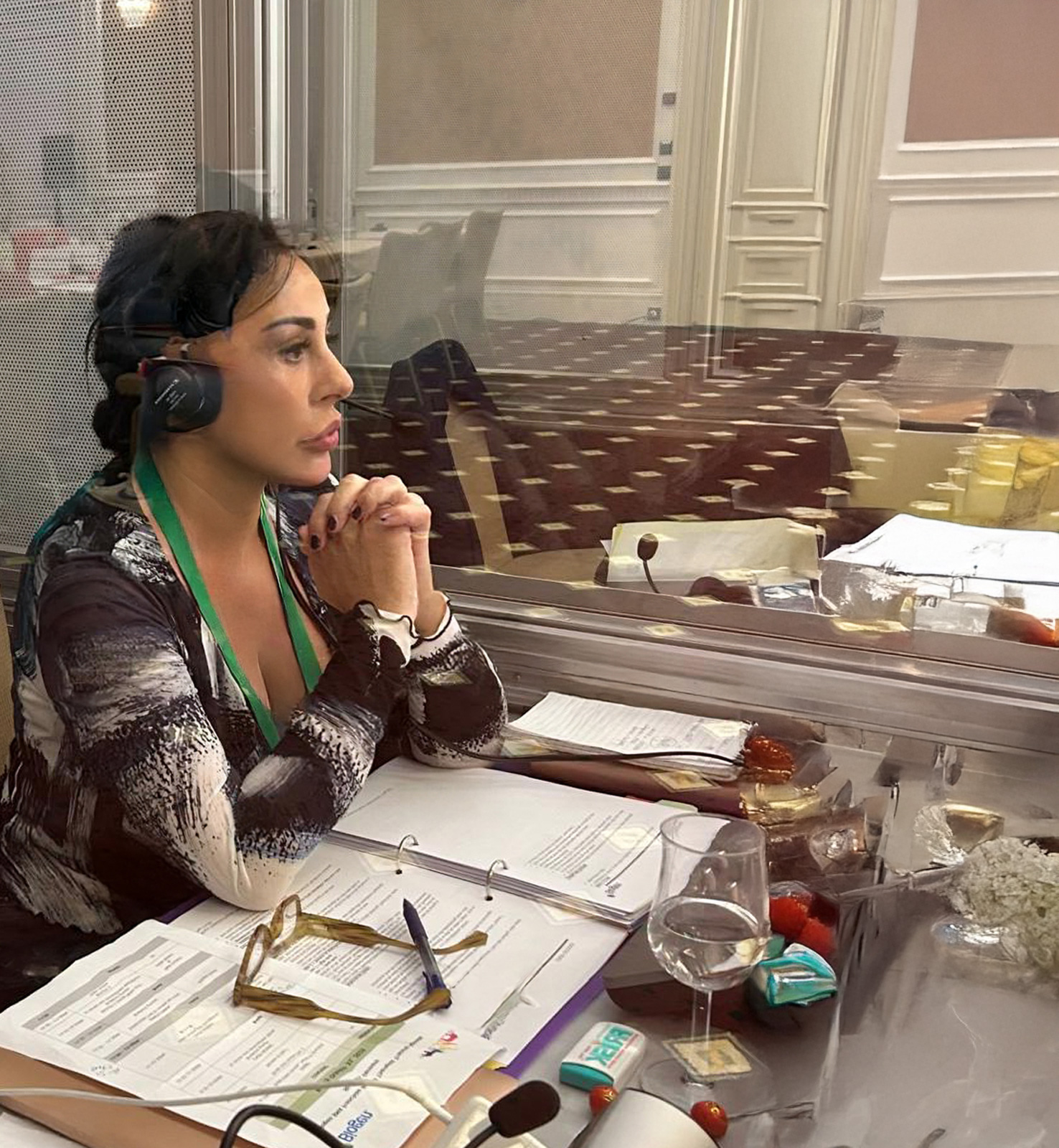
How to choose between interpreting services and how to best organize an event which requires the presence (onsite or online) of conference interpreters?
Step 1️⃣ – The answer is to rely on a professional who can suggest, during an initial consultation and at no cost, the best interpreting method for the occasion (international conferences, corporate meetings, incoming of diplomatic or commercial delegations, streaming broadcasts, and preference for in-person or remote options). All available information, such as the number of participants, event program, location, and topics covered, is vital for preparing a quote.
Step 2️⃣ – This information is crucial for preparing a customized quote, as the duration of the event determines whether one or two interpreters are needed (normally, for any event lasting longer than about an hour, two interpreters alternate every 30 minutes or so) or whether, in addition to the interpreting service, simultaneous interpreting booths and related technical equipment need to be rented.
Step 3️⃣ – Once the quote has been approved and a financial agreement has been reached, a visit to the location can be arranged in the case of simultaneous interpreting with booths or, where not necessary, pre-tests for online meetings.
Step 4️⃣– During the event, the team leader will monitor the smooth running of the event, acting as a liaison between technicians, organizers, speakers, and colleagues.
Professional interpreters do not charge an hourly fee but a dayly fee, as agreements are normally made in advance and the professional pencils out the dates in their calendar and confirm them once the contract is signed. The study of documentation and research carried out by professional to familiarize with the specific sectorial vocabulary requires the same commitment for a short conference as for an eight-hour conference, and this is the only reason behind the refusal of an hourly rate.
WORKING LANGUAGES
according to the AIIC (International Association of Conference Interpreters) classification)
🇮🇹 Italian “A”
🇬🇧 English “B”
🇵🇹 Portuguese “C”
🇫🇷 French “C”
Over 20 years of experience
Professional Profile and Curriculum Vitae
For detailed information about my professional career, my most significant collaborations, and the approach I take to my work, please consult my Professional Profile, available in PDF format in Italian, English, French, and Arabic, or request my Curriculum Vitae.
FAQs. The most common questions about interpreting
What is the difference between simultaneous, consecutive, and whispered interpreting?
- Simultaneous: for large events and multiple languages → requires technical equipment.
- Consecutive: for official events on stage in theaters or cinemas or even small groups → more time, but no technology. Consecutive interpreting is often combined with chuchotage. For example, the interpreter whispers the questions asked by journalists to the interviewee, but then the answer is translated into the microphone or aloud to the entire audience.
- Whispered interpreting: may or may not be combined with consecutive interpreting: for one or two guests → agile and discreet solution, no equipment required.
What is simultaneous interpreting?
Simultaneous interpreting is real-time oral translation: the interpreter listens to the speech in one language and translates it simultaneously into another, with a slight delay called décalage. It is mainly used in conferences, congresses, and international assemblies at European institutions, the UN, and NATO.
What is liaison interpreting?
Liaison interpreting, or business interpreting, is a form of oral interpretation in which an interpreter translates in real time between two or more parties speaking different languages, facilitating communication and mutual understanding in informal contexts such as meetings, business meetings, and bilateral diplomatic meetings, business negotiations, guided tours, business lunches, and gala dinners without the use of technical equipment. The interpreter does not simply translate literally, but also acts as a cultural and sectoral mediator, adapting to the level of formality and context and creating a flow of conversation.
What is consecutive interpreting?
It is a technique in which the interpreter listens to the speaker’s speech and takes notes (this is not shorthand: note-taking is taught at interpreting schools, but each professional adapts this technique according to his/her preferences); at the end of short sections (3-5 minutes), they reproduce the content in the target language. It does not take place simultaneously, but alternately with the speaker, who pauses (they are not interrupted by the interpreter) to allow the professional to translate.
What is whispered interpreting?
Whispered interpreting, or chuchotage, is a form of simultaneous interpreting without technical support. The interpreter translates what is said during a meeting or event in real time by whispering in the person’s ear. It is often combined with consecutive interpreting (in a press conference, for example, the interpreter whispers the questions asked to the interviewee, but the answer is reproduced in the target language into a microphone or aloud).
How can I request a quote?
You can request a personalized quote by filling out the online form Request a quote, specifying
- date of the event
- languages required
- number of participants
- modality (in-person or remote)
- program of the event